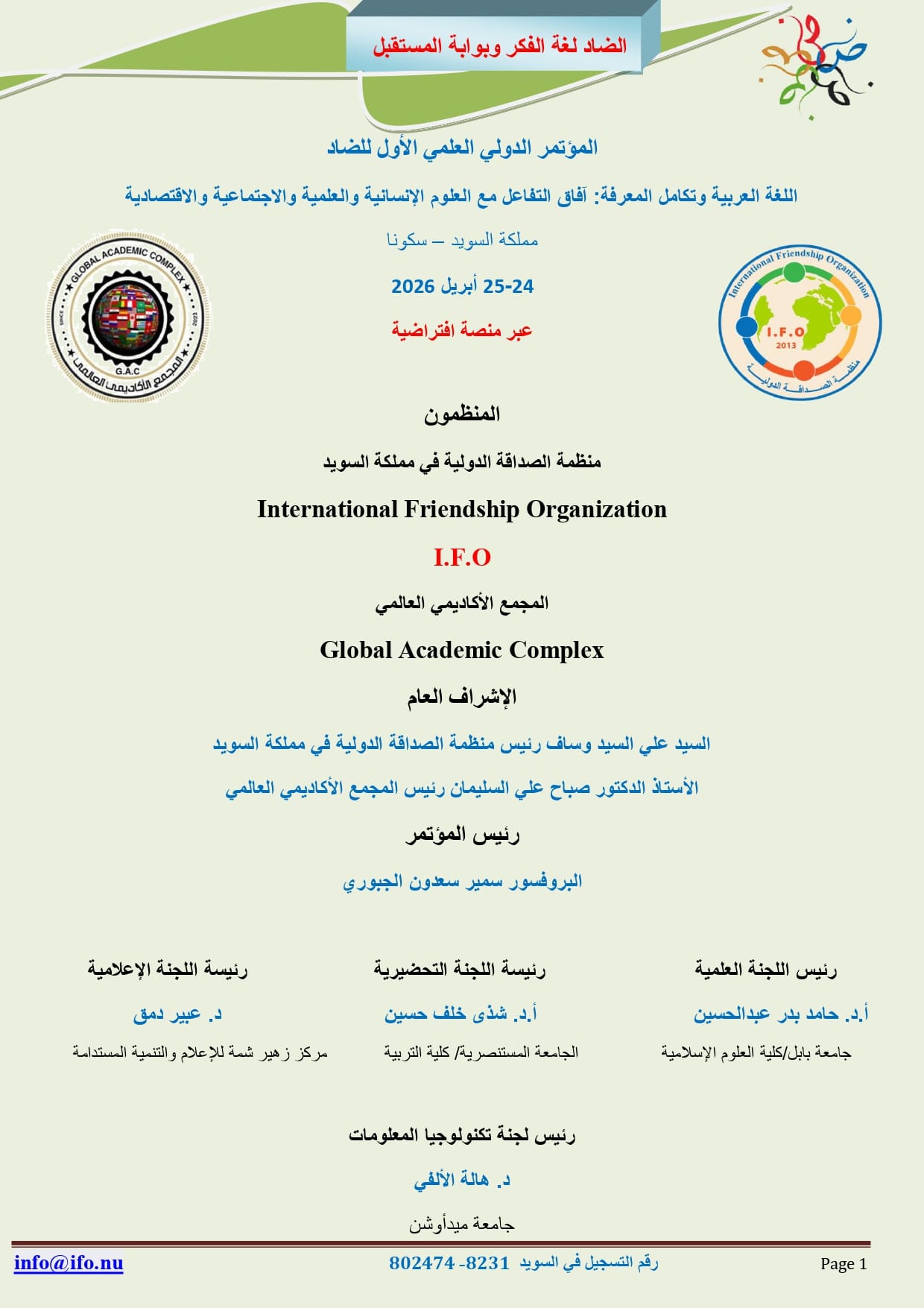
Arabic Language and Knowledge Integration: Horizons of Interaction with the Humanities, Scientific, Social, and Economic Sciences
Kingdom of Sweden – Skåne
24–25 April 2026
Virtual Platform
Organizers
- International Friendship Organization
Kingdom of Sweden
(I.F.O) - Global Academic Complex
General Supervision
- Mr. Ali Al-Sayyid Wasaf
President of the International Friendship Organization in the Kingdom of Sweden - Professor Dr. Sabah Ali Al-Sulaiman
President of the Global Academic Complex
Conference President
- Professor Samir Saadoun Al-Jubouri
Committees’ Chairs
- Chair of the Scientific Committee:
Prof. Dr. Hamed Badr Abdulhussein
University of Babylon / College of Islamic Sciences - Chair of the Preparatory Committee:
Prof. Dr. Shatha Khalaf Hussein
Al-Mustansiriya University / College of Education - Chair of the Media Committee:
Dr. Abeer Damq
Zuhair Shamma Center for Media and Sustainable Development
Head of the Information Technology Committee
- Dr. Hala Al-Alfi
MidOcean University
Conference Preamble
Based on the central position occupied by the Arabic language as a vessel of thought, a bridge for civilizational communication, and a tool for knowledge, and in recognition of its historical and contemporary impact on the production, transmission, and integration of sciences, the importance of holding the First International Scientific Conference on Al-Dhad emerges as a rigorous academic space for scholarly dialogue and interdisciplinary integration.
Throughout history, the Arabic language has played an effective role in building human civilization and in embracing religious, human, and natural sciences. It has been—and continues to be—a language capable of interacting with rapid scientific and intellectual transformations. In light of today’s digital revolution and knowledge globalization, an urgent need arises to reconsider the status of the Arabic language, explore the horizons of its interaction with various scientific fields, and envision its future within contemporary transformations.
The conference is an international, peer-reviewed scientific forum in which submitted research papers undergo precise academic review in accordance with approved academic standards, ensuring quality and rigor. Accepted papers will be published within peer-reviewed scientific outputs.
The conference seeks to promote rigorous scientific research, highlight the contribution of the Arabic language across various fields of knowledge, and explore its future prospects amid scientific and technological transformations through specialized academic tracks that combine authenticity and knowledge integration.
Target Audience
Academics and researchers – postgraduate students – specialists in Arabic language and various sciences – educational and cultural decision-makers.
Conference Themes
Theme 1: Arabic Language and Its Impact on Qur’anic and Hadith Studies
- Linguistic and rhetorical studies of the Qur’anic text and its sciences
- Arabic language and Tafsir (exegesis): traditional methodologies and contemporary trends
- Linguistic semantics in understanding the Prophetic Hadith and Sunnah
- Linguistic and rhetorical inimitability of the Qur’an and Hadith in light of modern linguistic approaches
Theme 2: Arabic Language and the Humanities
- Arabic language, philosophy, and human thought
- Arabic language and psychology and sociology
- Linguistic and critical studies in the humanities
- Language and cultural and civilizational identity
Theme 3: Arabic Language and Scientific & Applied Sciences
- Arabic language and scientific and technological research
- Arabization of sciences and scientific terminology
- Arabic language in scientific, medical, and engineering education
- Linguistic challenges in Arabic scientific publishing
Theme 4: Arabic Language and Economic & Administrative Sciences
- Arabic language in economic discourse
- Arabic language, entrepreneurship, and sustainable development
- Language and institutional and administrative communication
- Economic and financial translation
Theme 5: Arabic Language and Modern Technologies
- Artificial intelligence and Arabic language processing
- Digital transformation and Arabic language computing
- Digital Arabic content
- E-learning and the Arabic language
Theme 6: Contemporary Issues and the Future of the Arabic Language
- Arabic language and globalization
- Language planning policies
- Arabic language in international academic institutions
- Strategies for advancing the Arabic language globally
Participation Conditions
The Scientific Committee welcomes research abstracts that aim to present new and innovative scholarly treatments of the issues and topics related to the conference themes. Abstracts should be sent via email to:
qur.hamed.bader@uobabylon.edu.iq
Registration for participation is completed by filling out the participation form via the following link:
https://forms.gle/EohLMMwTcnG3QAdw9
The researcher must submit the abstract in Word format no later than 20 February 2026, including the research problem, objectives, main themes, and an outline, in accordance with the following conditions:
- The research topic must fall within the conference themes
- The research title must be clear and precise
- The researcher’s name must be written at the top of the abstract page, with institutional affiliation and country of residence
- The abstract must not be fewer than 200 words and not exceed 250 words
- A brief academic CV and a personal photo must be attached
- Contact information must be included, including email address and mobile phone number with WhatsApp or Telegram
- Abstracts are reviewed upon receipt, and authors of accepted abstracts will be notified and invited to submit full papers
Full Paper Submission Conditions
Full papers must be submitted no later than 15 March 2026, subject to the following conditions:
- The research must adhere to scientific research standards and academic requirements
- The research must be original
- The research must not have been previously published in any medium, print or electronic
- Papers must be submitted in Word format, using Sakkal Majalla font, size 14 for the main text, 12 for references, with 1.5 line spacing, and the title in bold size 16
- The first page must include the full research title, researcher’s name, academic title, institutional affiliation in Arabic and English, email address, and mobile phone number; in case of multiple authors, all names and contact details must be included
- The paper must be between 12 and 20 pages, including references, tables, figures, and illustrations
Conference Participation Procedures
- Submitted papers are subject to plagiarism detection (Plagiarism). Papers exceeding the internationally accepted similarity rate will be rejected.
- Authors will be notified via email upon receipt of their papers. After peer review, authors may be requested to make formal or substantive revisions prior to publication and must comply with the required modifications.
Important Dates
- Deadline for abstract submission: 20 February 2026
- Deadline for final paper submission: 15 March 2026
- Announcement of the scientific program: 15 April 2026
- Conference dates: 24–25 April 2026
Conference Benefits
- Participation is free of charge
- The top three winning papers will receive the International Friendship Medal issued by the International Friendship Organization, supported by an official administrative order
- All authors of accepted papers will receive certificates of participation and letters of appreciation
- All attendees will receive certificates of appreciation
- Accepted papers may be published, after peer review, in Al-Dhad Journal in a special issue of the conference for those wishing to publish, for a fee of 100,000 Iraqi dinars or equivalent
- Conference proceedings will be published in a special electronic booklet and officially registered in the Kingdom of Sweden
- Honorary membership cards will be granted by the organization to university presidents, deans, scientific institutions, and participating researchers
Preparatory Committee
- Prof. Dr. Hamdiya Saleh Dali Al-Jubouri – Iraq – Rapporteur – Al-Qadisiyah University / College of Education
- Asst. Prof. Samira Saadoun Mustafa Al-Jubouri – Iraq – Member – Middle Technical University / Al-Mansour Medical Technical Institute
- Lecturer Yusra Abdul-Sattar – Iraq – Member – University of Baghdad / College of Languages
- Asst. Prof. Dr. Haidar Turki Mousa Al-Mousawi – Iraq – Member – Al-Qasim Green University
- Asst. Prof. Dr. Mona Hamed Taha Al-Naimi – Iraq – Member – Ministry of Education
- Lecturer Iman Abdul-Jabbar Mahmoud – Iraq – Member – Ministry of Education
- Dr. Mohammed Rafiq Ali – Iraq – Member – Al-Mansour Technical Institute
- Dr. Majda Abbas Mohammed Ali – Iraq – Member – Ministry of Education / Najaf Directorate of Education
- Asst. Prof. Dr. Yusra Khalaf Hussein – Iraq – Member – University of Baghdad / Ibn Rushd College of Education
- Asst. Prof. Dr. Maysa Taha Khamas – Iraq – Member – Al-Mustansiriya University / College of Arts
- Mr. Khaled Manthar Hamza – Iraq – Member – Director of the Organization’s Kurdistan Region Branch
- Prof. Dr. Nirvana Hussein Al-Sabri – Egypt – Member – Nile European University
- Prof. Dr. Randa Mustafa Al-Deeb – Egypt – Member – Tanta University / College of Education
- Asst. Prof. Dr. Heba Ali Shaat – Egypt – Member – Al-Azhar University / College of Agriculture (Girls)
- Asst. Prof. Dr. Nada Mahdi Al-Abadi – Egypt – Member – Deputy Director of the Organization’s Egypt Branch
- Dr. Naela Jreis Haddad – Palestine – Member – Head of the Executive Committee, Global Academic Complex
- Dr. Suad Kloob – Palestine – Member – Director of the Organization’s Palestine Branch
- Dr. Mona Ahmed Abu Hamdiya – Palestine – Member – Publications and Scientific Research Unit
- Dr. Salman Saud Al-Balawi – Saudi Arabia – Member – University of Tabuk / Tayma University College
- Dr. Maysoun Muzki Al-Anzi – Saudi Arabia – Member – Ministry of Education
- Dr. Iman Al-Anzi – Saudi Arabia – Member – Ministry of Education
- Dr. Alaa Mohammed Abdul-Razzaq – USA – Member – Director of the Organization’s USA Branch / Florida
- Ms. Kawthar Al-Shammari – USA – Member – Director of the Organization’s USA Branch
- Dr. Fayez Manaa Al-Adwani – Jordan – Member – Director of the Organization’s Jordan Branch
- Dr. Adel Mohammed Al-Qashbari – Yemen – Member – President of Friendship Academy for Training and Development
- Ms. Shatha Farouk Othman – Sudan – Member – Director of the Organization’s Sudan Branch
Scientific Committee
- Prof. Dr. Abdul-Hussein Ahmed Al-Khafaji – Iraq – Rapporteur – University of Diyala / College of Basic Education
- Prof. Dr. Khamis Fazaa Ameer – Iraq – Member – University of Anbar / College of Education
- Prof. Dr. Mohammed Dhnoun Younis Al-Fathi – Iraq – Member – University of Mosul / College of Education for Women
- Prof. Dr. Hussein Hussein Zaidan – Iraq – Member – Ministry of Education / Diyala Directorate
- Prof. Dr. Maysa Saeb Rafi – Iraq – Member – University of Baghdad / College of Islamic Sciences
- Prof. Dr. Ahmed Safaa Abdul-Aziz – Iraq – Member – University of Anbar / College of Education
- Prof. Dr. Jinan Nazim Hamid – Iraq – Member – Al-Mustansiriya University / College of Arts
- Prof. Dr. Taraf Tareq Al-Nahar – Turkey – Member – Islamic University of Science and Technology, Gaziantep
- Prof. Dr. Abdullah Abdul-Qader Al-Taweel – Turkey – Member – Recep Tayyip Erdoğan University / College of Theology
- Prof. Dr. Aisha Saeed Al-Atwi – Saudi Arabia – Member – University of Tabuk / College of Education and Arts
- Prof. Dr. Saud Eid Al-Anzi – Saudi Arabia – Member – University of Tabuk / College of Education and Arts
- Prof. Dr. Mohammed Mahmoud Abdul-Qader – Egypt – Member – 6 October University / College of Education
- Prof. Dr. Susan Zakaria Shaheen – Egypt – Member – Matrouh University
- Prof. Dr. Ayman Ghabashi Zughayb – Egypt – Member – Global Leadership University for Islamic and Human Sciences
- Prof. Dr. Aisha Abiza – Algeria – Member – Amar Thliji University / College of Arts and Languages
- Prof. Dr. Reda Amer – Algeria – Member – Batna University
- Prof. Dr. Wasila Merbah – Algeria – Member – Mila University
- Prof. Dr. Nassima Kraybaa – Algeria – Member – Mila University
- Prof. Dr. Amina Taybi – Algeria – Member – Sidi Bel Abbes University
- Prof. Dr. Abdul-Wahab Abdullah Al-Maamari – Jordan – Member – Editor-in-Chief, Scientific Conferences Journal
- Prof. Dr. Haifa Awad Nazzal Al-Hawamdeh – Jordan – Member – Najran University
- Prof. Dr. Monji Ben Al-Habib Al-Ashab – Tunisia – Member – University of Manouba
- Prof. Dr. Khalifa Ben Al-Hadi Al-Maysawi – Tunisia – Member – University of Carthage / Higher Institute of Languages
- Prof. Dr. Abdul-Aziz Ibrahim Munadel – Morocco – Member – Ibn Tofail University / College of Languages, Arts, and Humanities
- Prof. Dr. Mohammed Fadel Adda – Morocco – Member – Regional Academy of Education and Training
- Prof. Dr. Ahmed Faraj Ali Al-Khazaali – Libya – Member – Omar Al-Mukhtar University
- Prof. Dr. Fahmi Hassan Ahmed Youssef – Yemen – Member – University of Aden / Dean of the College of Education
- Dr. Ahmed Saleh Ali Bafadel – Yemen – Member – Head of Research and Development Studies Center, Quran University
- Dr. Sanusi Abu Bakr Ramadan – Nigeria – Member – Sule Lamido University
- Prof. Dr. Mohammed Fadl Ahmed Issa – Oman – Member – Ain Shams University
Media Committee
- Lecturer Miqdad Hussein Ali Al-Mousawi – Iraq – Rapporteur – University of Kufa / College of Arts
- Ms. Dalia Ahmed Abdel-Rab – Egypt – Member – Advisor, International Friendship Organization
- Dr. Rafeef Al-Faris – USA – Member
- Dr. Roula Mohammed Murad – Lebanon – Member – Humanitarian Affairs Advisor, International Friendship Organization
Information Technology Committee
- Dr. Mona Mamdouh Al-Husseini – Egypt – Member – International Higher Institute of Media
- Dr. Hadeer Ahmed Mohammed – Egypt – Member – Helwan University
- Dr. Hala Hamdy Ghoraba – Egypt – Member – Al-Jazeera Higher Institute of Media and Communication Sciences
- Dr. Asmaa Masaad Abu Aita – Egypt – Member – 6 October University
Contact Us
For inquiries, please contact us via WhatsApp or Telegram at the following numbers:
- 0064737032653
- 009647828299600
- 009647703706781
Official Conference Telegram Channel – I.F.O
https://t.me/+bXhDCcIUsLsyZGE8